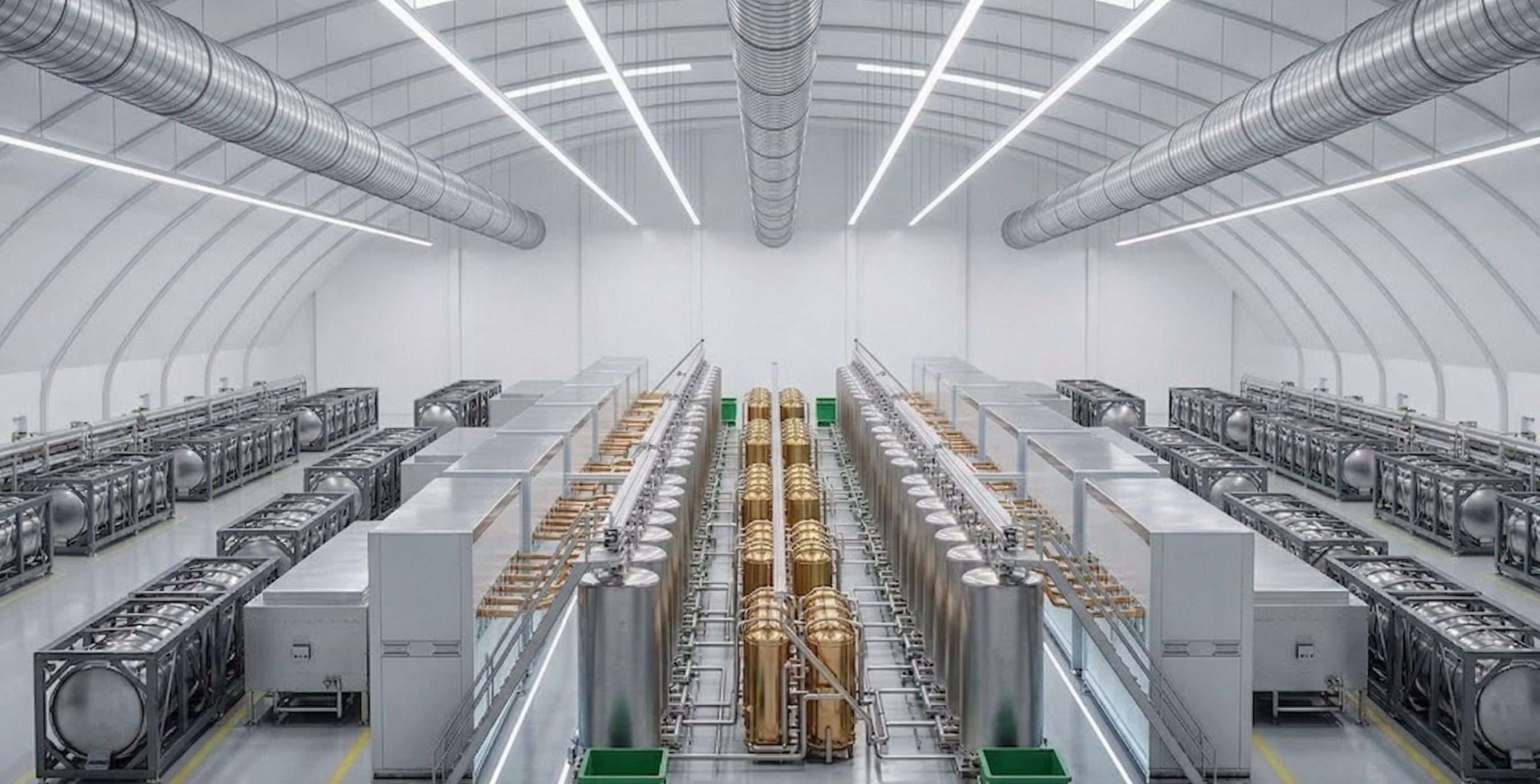
A manufacturing company. Not a waste company.
The distinction matters for Hillsborough County's balance sheet, regulatory posture, and long-term fiscal structure.
Carbotura builds, owns, and operates Advanced Circular Manufacturing (ACM) facilities under 30-year Circular Supply Agreements. The facility converts residual material streams — the MSW, WTE ash, biosolids, and tires that currently require disposal — into synthetic graphite, graphene compounds, and recovered minerals using the MCR (Microwave Catalytic Reforming) process.
MCR is anoxic and oxygen-free — there is no combustion and no stack. ACM facilities are classified under manufacturing NAICS codes (Sector 31–33), not solid waste codes. The classification distinction governs accounting treatment, regulatory authority, and the structural form of the CSA itself.
Under a Circular Supply Agreement, the material Hillsborough County currently pays to dispose of becomes a manufacturing feedstock the County is paid to supply. The Beneficiation Fee (TMC Fee) replaces previously committed disposal spending. At $100 per ton — $5/ton above the County's current blended FWDC of approximately $95 per ton (October 2024 Resolution) — the fee carries a modest Year 1 differential against a 2.5%/yr escalator below typical disposal-cost inflation. The Circular Royalty™, beginning 13 months later, returns more than was paid.
The Reworld™ RRF operating contract renewal cycle and the Southeast County Landfill remaining-life arc are both active decision instruments in front of the Board of County Commissioners. The CSA framework fits inside that window without committing the County.
Why this matters — what Carbotura is offering Hillsborough County
Five structural facts that define the decision window for the Board of County Commissioners.
ACM is an anoxic, oxygen-free manufacturing process — not combustion, not incineration, not waste treatment. ACM facilities are classified under manufacturing NAICS codes (Sector 31–33). Solid waste codes (562212 / 562213 / 562219 / 562920) are expressly excluded. Both parties commit to the RPT pathway; the endpoint is categorical — manufacturing classification across all permitting, licensing, and regulatory contexts. Interim bridging authorities may apply during the transition. Manufacturing classification is confirmed as a precondition of agreement execution.
Hillsborough County's Resource Recovery Facility (1,800 TPD WTE) is operated by Reworld™ (formerly Covanta) under a county-owned-facility operating contract. The renewal cycle is an active decision instrument in front of the Board. The CSA framework runs in parallel — it does not require any change to the Reworld™ relationship, but it does provide a 30-year planning anchor independent of contractor renewal cycles.
The Southeast County Landfill (15960 County Rd. 672, Lithia) is county-operated and on a finite remaining-life trajectory. Hillsborough Heights, a separate post-closure care site, presents an additional Exogenesis™ candidate. Both are eligible for the Exogenesis™ Royalty bonus (subject to Waste Characterization Study). A CSA structured during the renewal window preserves landfill optionality; deferring it forfeits the 24-month operational pathway against the landfill arc.
At $100 per ton, the Beneficiation Fee sits $5/ton above the County's current blended FWDC of approximately $95 per ton (Hillsborough County Solid Waste Rates Resolution, October 2024). The 2.5% annual escalator is below the typical trajectory of market disposal cost inflation and contractor renegotiation. From the perspective of the County's 30-year disposal cost trajectory, the CSA is at effective long-run parity with the existing system — without the recurring renegotiation cycle.
Gross cost displacement and Circular Royalty™ cash flow are quantified separately. At steady state, the Circular Royalty™ is designed to exceed the Beneficiation Fee on a per-ton basis.
Phase Initial 400 TPD addresses ~20% of the County's 2,000 TPD addressable volume across MSW, WTE ash, biosolids, tires, Pasco regional feedstock, and commercial/industrial streams. Phase Expanded scales to the full 2,000 TPD using the same site infrastructure and CSX Wildwood Subdivision rail access. The CSA locks the Beneficiation Fee, establishes a structured royalty return stream, and runs for 30 years with perpetual continuation unless either party serves a 24-month Non-Renewal Notice.
Two paths for Hillsborough County
- Beneficiation Fee: $100/ton, 2.5% annual escalator
- Circular Royalty™: 120% of the current-year Beneficiation Fee, +1pp/yr escalator (148% by Year 30 — $295/ton on a $100/ton base)
- Royalty commencement: 13 months after corresponding Beneficiation Fee payment (rolling monthly)
- 30-year CSA term, perpetual continuation language
- 18-month Parent Performance Guarantee
- Regulatory Predicate Transition (RPT) — manufacturing NAICS required
- GASB/US GAAP accounting treatment
Where a qualifying legacy landfill has been identified, the CSA may include an Exogenesis™ Royalty structured as a separate dual-stream payment for legacy material remediation. For Hillsborough County, two candidate qualifying sites have been identified: the Southeast County Landfill (Lithia, FL) — county-operated, active — and Hillsborough Heights — a separate post-closure care site.
Legacy material accumulated over the operational life of either site may qualify for a structured Exogenesis™ Royalty stream under a separate agreement appended to the primary CSA. This option is conditional on confirmed feedstock characterisation and does not alter the primary CSA commercial terms. Where elected under the CSA, the GASB 18-equivalent post-closure care liability is extinguished at CSA execution.
Subject to Waste Characterization StudyKey figures at a glance
Planning-basis estimates. ESTIMATED figures are subject to site-specific verification and Waste Characterization Study outcomes.
vs. ~$95/ton current FWDC
+1 pp/yr escalator thereafter
Florida-based manufacturing roles
Gross cost displacement shown separately per the Separate Transaction Principle. Full 30-year fiscal model in the Proposal document. ESTIMATED
Employment and economic contribution
Phase Initial (400 TPD)
estimate at Phase Initial
Phase Expanded (2,000 TPD)
Circular Royalty™ projections across deployment configurations
Gross Circular Royalty™ and Beneficiation Fee shown independently per the Separate Transaction Principle.
| Capacity | Annual TPY | Beneficiation Fee · Year 1 | Circular Royalty™ · Year 2 | 30-Year Gross Royalty | Direct FTE |
|---|---|---|---|---|---|
| 400 TPD ← Phase Initial | 146,000 | $14.60M | $17.52M | ~$874M ESTIMATED | 100 |
| 800 TPD · Phase Medium | 292,000 | $29.20M | $35.04M | ~$1.75B ESTIMATED | 200 |
| 1,200 TPD | 438,000 | $43.80M | $52.56M | ~$2.62B ESTIMATED | 300 |
| 2,000 TPD · Phase Expanded | 730,000 | $73.00M | $87.60M | ~$4.37B ESTIMATED | 500 |
Circular Royalty™ (Year n) = (120% + (n−1)pp) × that year’s Beneficiation Fee. Royalty payments begin 13 months after corresponding Beneficiation Fee payments. At steady state, the Circular Royalty™ is designed to exceed the Beneficiation Fee on a per-ton basis. 30-year figures use a planning-basis multiplier with annual escalation as defined in the Proposal document.